High-Silicon Cells and Clamping Pressure: What Fraunhofer ISE’s 1,000-Cycle Result Means for Pack Design
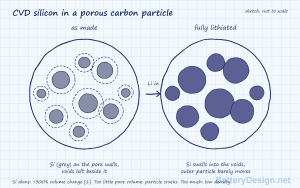
Hand-drawn sketch on squared paper: a porous carbon particle with silicon on the pore walls before lithiation, and the same particle after lithiation with the silicon swollen into the empty pores while the outer particle stays almost the same size.

Fraunhofer ISE has run a 25 Ah pouch cell with a silicon-rich anode through more than 1,000 full cycles and kept over 83% of its capacity [2]. The same lab ran the cell at two clamping pressures, and the result depends heavily on which one. Pressure is the lever a pack designer controls, so this … Read more
The impact of state of charge on transport in silicon anodes

Quantifying microstructure differences across Gr-SiOx anodes stopped at states of charge from 0 to 100%. Introduction Fast charging in graphite-silicon suboxide (Gr-SiOx) composite anodes depends on maintaining efficient ionic transport as the electrode evolves during lithiation. This is particularly challenging because the two active phases undergo different degrees of dimensional change. SiOx offers substantially higher … Read more

Stack Pressure & Interfacial Resistance for Pack Designers

Solid state cell interfacial pressure - pencil drawing of a huge press

Every solid-state chemistry roundup mentions that cells need “stack pressure,” usually as a single line in a spec table. What that line means for the person actually designing the pack around the cell: This gets skipped almost everywhere. This is the pack-design follow-on to our cell-level piece on What’s the right stack pressure?, which covers … Read more

AI-Guided Materials Discovery: Bayesian Optimisation for Electrolyte Formulation

Closed-loop diagram of Bayesian optimisation for autonomous electrolyte formulation discovery: propose candidate, robotic synthesis, measure performance, update model

Choosing a solvent blend or additive package is fundamentally a search problem: a handful of components, each at a continuous concentration, combine into a space with far more candidate formulations than anyone could test by hand. The Electrolyte Solvent Ratios and Electrolyte Additives pages describe what’s in that space and why each component matters. This … Read more

Grain Boundary Dendrite Growth in Solid-State Electrolytes

grain boundaries and dendrites in solid state

Lithium dendrites growing through a solid electrolyte do not behave like the diffuse, roughly uniform plating seen at a liquid electrolyte interface. In a polycrystalline ceramic or a cold-pressed sulfide pellet, the microstructure itself dictates where lithium goes: dendrites overwhelmingly nucleate and propagate along grain boundaries rather than through the bulk of individual grains, even … Read more

Engineering the LFP Cathode-Electrolyte Interface

three routes to LFP-CEI engineering

The reference page on LFP’s cathode-electrolyte interface covers coatings and doping as the two established levers. There is a third, newer one that deserves its own look: treating the CEI itself, or the process that forms it, as the thing being engineered. Three recent papers take genuinely different routes to that same goal, and reading … Read more