
Once the pack heat is known, the first cooling question is how much coolant has to flow to carry it away. This calculator gives the flow rate for a heat load and an allowable coolant temperature rise, for water, the common water-glycol mixes or any fluid whose properties you enter, and splits it across parallel cold plates. Take the heat load from the Cell Heat Generation Calculator; for plate layout see Cooling Plate Design.
Cold Plate Coolant Flow Calculator
Flow rate needed to carry a heat load away at a given coolant temperature rise, for water, water-glycol or any fluid you enter.
1. Heat load and coolant
2. Circuit (optional)
Water-glycol properties use the specific heat and specific gravity correlations in the MEGlobal Ethylene Glycol Product Guide, interpolated in concentration and temperature (valid here from 0 to 60 wt% and -10 to 65 °C). Volume to weight conversion is from the same guide at 20 °C. This is an energy balance only: it says nothing about the temperature difference between cell and coolant, which depends on the cold plate and thermal interface. The 40% pump efficiency is a placeholder: use the figure for your pump.
The Energy Balance
All the heat from the cells ends up in the coolant, so:
where ṁ is the mass flow (kg/s), Q̇ the heat load (W), cp the coolant specific heat (J/kg·K), ΔT the rise from inlet to outlet (K), V̇ the volume flow (m³/s) and ρ the coolant density (kg/m³). Multiply V̇ by 60,000 for L/min. If a pressure drop Δp (Pa) across the circuit is known, the hydraulic power the pump has to deliver is:
Divide by the pump efficiency for its electrical power. Hydraulic power rises with flow times pressure drop, and pressure drop itself rises steeply with flow, so a tight ΔT costs pump energy as well as flow.
Coolant Properties
For water and ethylene glycol mixes the calculator uses the correlations in the MEGlobal Ethylene Glycol Product Guide [1]: specific heat as a quadratic in temperature for each weight percentage, and specific gravity as a quadratic in weight percentage at 0, 50, 100 and 150 °F. It interpolates between them, so changing the mean coolant temperature moves both properties. Coolant mixes are usually specified by volume, and the guide’s conversion table at 20 °C puts 30, 40 and 50 vol% at about 32, 43 and 53 wt% [1].
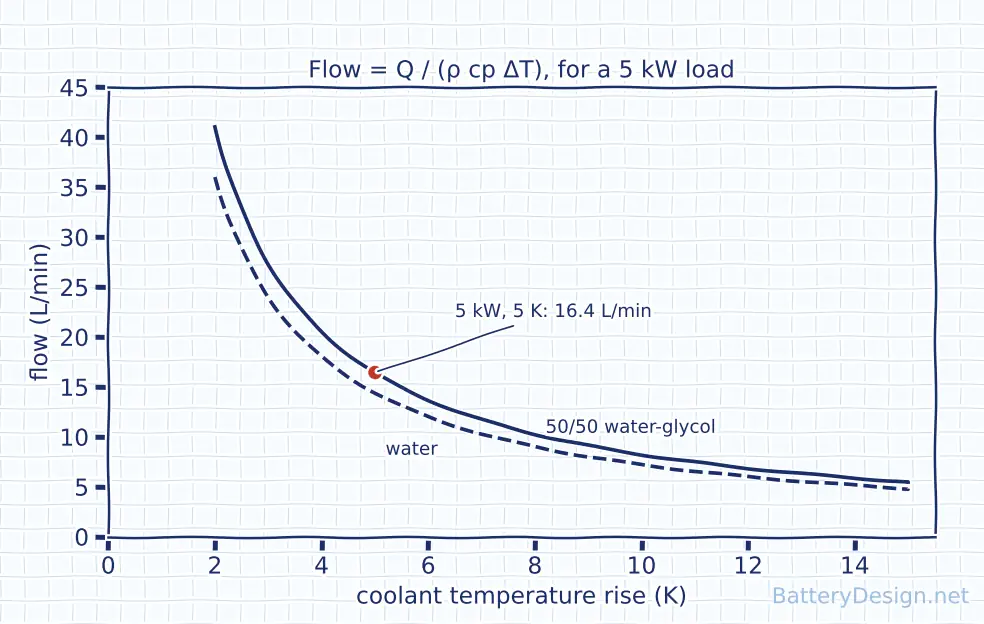
| Coolant at 25 °C | cp (J/kg·K) | ρ (kg/m³) | Flow for 5 kW, 5 K (L/min) |
|---|---|---|---|
| Water | 4,186 | 995 | 14.4 |
| 50/50 water-glycol (53 wt%) | 3,432 | 1,065 | 16.4 |
Glycol’s higher density only partly offsets its lower specific heat, so 50/50 needs about 14% more flow than water for the same duty. For a dielectric fluid in an immersion system, or a propylene glycol mix, choose “Other fluid” and enter the supplier’s values.
Choosing the Coolant Temperature Rise
The coolant ΔT is a design choice, not a property. In a plate where the coolant runs past the cells in series, the cells at the outlet see coolant that is ΔT warmer than the cells at the inlet, so a large ΔT shows up directly as cell-to-cell temperature spread and uneven ageing. A small ΔT means more flow, bigger pipes and more pump power. Splitting the flow across parallel plates does not change ΔT for a given total flow, but each plate then carries less flow over a shorter path, which cuts the pressure drop and so the pump power.
The flow from this calculator is the minimum needed to carry the heat. It does not say how hot the cells get: that depends on the thermal resistance from cell to coolant through the thermal interface, the plate wall and the coolant film. See Options for Thermal Interface Materials and What Is the Optimum Design of a Cooling Plate for Uniform Cooling?.
References
- MEGlobal, Ethylene Glycol Product Guide, form 001-00005-0508-CRCG: Figure 8 (specific heats), Figure 17 (specific gravities) and Table 6 (volume percent vs weight percent at 20 °C). MEGlobal
See also: Cell Heat Generation Calculator, Cooling Plate Design, Coolants, Battery Cooling Options, Cell to Cell Temperature Gradient, Optimum Cooling Plate Design, Battery Calculators
Get the next teardown in your inbox
New teardowns, benchmarks and design data from BatteryDesign.net, free by email. Unsubscribe any time.