
What actually changes when a 20 ft BESS container uses sodium-ion cells instead of LFP? Using CATL’s own pair, a 587 Ah LFP cell and a 316 Ah sodium-ion cell it says shares the same system architecture, the headline answer is container energy: roughly half. This post sets out the cell and container numbers we could verify, shows the arithmetic, and says how to judge the cycle-life and temperature claims.
The verdict first
For a developer, sodium-ion does not drop into the same footprint and deliver the same energy. On the figures we found, the sodium container holds about half the energy of the LFP one for the same 20 ft footprint, so a given site needs about twice the containers, plus the pad, cabling and power conversion that go with them. The case for sodium therefore has to come from cold-climate performance, supply security, cost per cell or the cycle-life claims, not from density. Whether those claims hold up is the next section.
Cell level
| Item | CATL LFP storage cell | CATL sodium-ion storage cell |
|---|---|---|
| Capacity (Ah) | 587 [1] | 316 [2]; “300+” in an earlier article [3] |
| Nominal voltage (V) | Not found in sources read | Not found in sources read |
| Energy per cell (kWh) | Not calculated: voltage not verified | Not calculated: voltage not verified |
| Energy density (Wh/kg) | Not found in sources read | About 160 [3] |
| Anode / cathode | Not stated in sources read | Hard carbon / layered oxide composite [3] |
| Current collectors | Not stated in sources read | Aluminium foil rather than copper [3] |
| Claimed cycle life | Not stated in sources read | 15,000 cycles at 25 °C, 9,000 at 45 °C [2]; more than 15,000 to 80% retention, conditions not stated [3] |
| Claimed temperature range | Not stated in sources read | -40 to 70 °C at cell level [3] |
Energy per cell is capacity times nominal voltage, so once the voltage is verified from the datasheets the table can be completed: Ah × V gives Wh. We have not guessed the voltage. The company states the sodium cell fits the same can and system architecture as the 587 Ah LFP cell, including container, module, BMS and power conversion [2][3]. That compatibility is a CATL claim, and the compatibility is the reason the container comparison below is like for like. Our Sodium-Ion Cell Characteristics post covers the cell physics, and Large-Format BESS Cells covers the LFP side.
Container level
| Item | CATL Tener S (LFP) | CATL sodium-ion container |
|---|---|---|
| Energy (MWh) | 6.017 (unverified secondary source) | 3.07 [2] |
| Mass (t) | 45 (unverified secondary source) | About 47 [2] |
| Form factor | 20 ft | Standard 20 ft [2] |
| Energy per tonne (kWh/t), our arithmetic | 133.7 | 65.3 |
| Containers per GWh, our arithmetic | 166 | 326 |
The sodium container carries about 51% of the energy of the LFP one (3.07 / 6.017, our arithmetic) while weighing slightly more. For the same site energy, that is roughly 160 more containers per GWh. Halving the energy per container affects land, foundations, cable runs, the number of power conversion and transformer blocks, auxiliary loads and fire-separation distances. How much each of those costs depends on the project, so we leave the cost judgement for Nigel’s procurement experience below.
How to judge the cycle-life and temperature claims
- Check the conditions. The SNEC figures give 15,000 cycles at 25 °C and 9,000 at 45 °C [2], while a CATL press contact quoted elsewhere gives 10,000 at up to 45 °C [4]. A claim without temperature, depth of discharge and rate is not comparable.
- Separate cell from system. The cell range of -40 to 70 °C [3] is not the system range of -20 to 45 °C reported for the Tener Sodium product, and the 92% capacity retention below -20 °C is a system-level claim [4].
- Note the stage. Initial Chinese shipments were reported from September 2026 and international deliveries from June 2027 [4], so field evidence at this scale is limited. These are manufacturer claims and we found no independent test report.
Other sodium data points exist, for example a Rept 320 Ah sodium cell at 20,000 cycles and 97% or higher energy efficiency [2], but these too are company claims without a published method. Our reading is that sodium is a credible option for cold sites and for buyers who want to diversify away from lithium, and that the density penalty is real and should be priced in. The Grid BESS Duration Classes page helps decide which duration class tolerates the extra footprint, and the Mass Production Sodium-Ion Pack post gives the vehicle-side context.
Normalise the cycle claim before comparing
A cycle number cannot be compared with another until four conditions are attached to it: the end-of-life threshold, the temperature, the depth of discharge and the C-rate. Lining up the sodium-ion storage claims published so far shows how few of those boxes are filled.
| Cell | Claimed cycles | End of life | Temperature | DoD and C-rate | Source |
|---|---|---|---|---|---|
| CATL Tener Sodium | 15,000 | 70% SOH | 25 °C | Not stated | [2][5] |
| CATL Tener Sodium | 9,000 or >10,000 | Not stated separately | 45 °C | Not stated | [2][4][5] |
| CATL 300+ Ah storage cell | >15,000 | 80% capacity | Not stated | Not stated | [6] |
| Hithium ∞Cell N162Ah | >20,000 | 70% SOH | Not stated | Not stated | [7] |
| Hithium ∞Cell N785Ah | 20,000 | Not stated | Not stated | Not stated | [8] |
| EVE NF155L (NFPP) | >30,000 | Not stated | Not stated | Not stated | [9] |
| Rept 320 Ah | 20,000 | Not stated | Not stated | Not stated | [2] |
Two things stand out. CATL has put both a 70% and an 80% end of life against the same 15,000-cycle headline [5][6]. These are different claims: if fade were linear, a cell at 80% after 15,000 cycles would not reach 70% until about 22,500 cycles (our arithmetic). Our reading is that the two figures belong to different cell generations or test conditions, but CATL has not said which. Second, CATL is the only maker to put a temperature against its number, and the 45 °C figure itself differs between sources.
Independent data is a long way behind. The largest open ageing study we could find took 70 commercial layered-oxide and hard-carbon cells to as many as 5,000 equivalent full cycles, and found sodium plating at the anode under every operating condition tested [10]. That is a third of the lowest headline in the table.
For a bankability or TCO model, treat a sodium-ion cycle figure without its end of life, temperature, DoD and C-rate as a placeholder, and ask for the test report behind it. Our Developing a Lifecycle Test Procedure and Cell Cycle Lifetime pages set out what a credible test should state.
Ask where the RTE meter sits
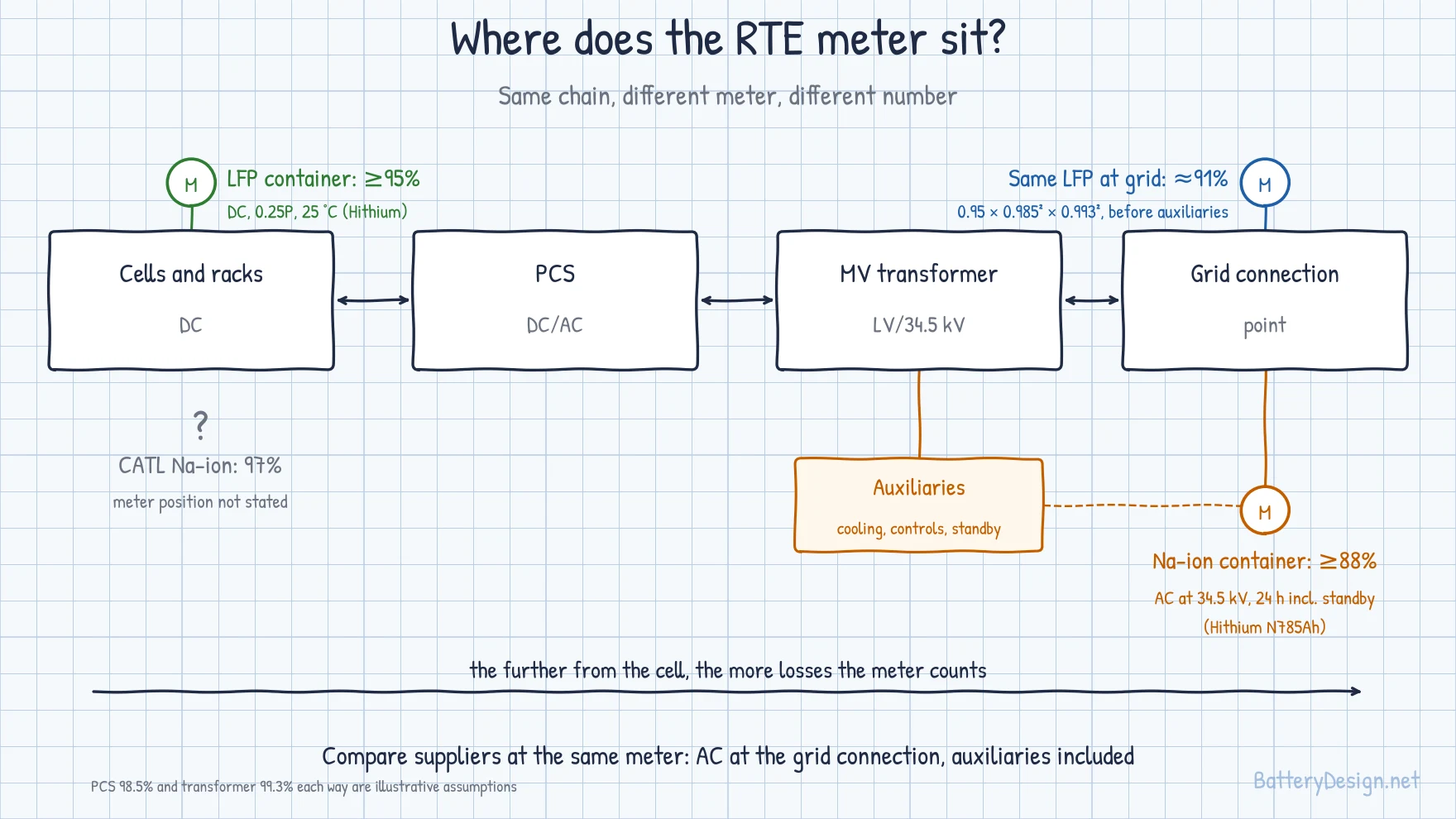
Round trip efficiency has the same problem. A figure means little without its measurement boundary: the further from the cell the meter sits, the more losses it counts and the lower the number. Sodium-ion is sometimes said to beat LFP on round trip efficiency, but the published figures do not yet support a ranking.
| Boundary | Losses counted | Published example |
|---|---|---|
| DC, rack or container | Cell resistance, busbars, contactors | Hithium LFP container: ≥95% at 0.25P/0.25P and 25 °C [11] |
| Not stated | Unknown | CATL sodium-ion: 97% “energy conversion efficiency” [5] |
| AC at medium voltage, 24 h including standby | Adds PCS, MV transformer, cooling and control standby | Hithium N785Ah sodium-ion container: ≥88% at 34.5 kV [12] |
A quick calculation shows why these cannot be ranked. Start from the 95% DC figure and assume, for illustration only, 98.5% for the PCS and 99.3% for the transformer, each passed twice:
That is before any cooling or standby load, which then comes off according to climate, duty cycle and cooling design. So an LFP container quoted at 95% DC and a sodium-ion container quoted at 88% AC over 24 h could be level, or either could be ahead. The published numbers cannot tell us which.
When comparing chemistries, ask every supplier for RTE at the same boundary, C-rate, temperature and time window. AC at the point of interconnection including auxiliaries is the one to standardise on, because that is the energy the project actually sells. See AC-Coupled vs DC-Coupled BESS for where the conversion losses sit.
References
- CATL 587 Ah LFP storage cell: shipment and mass-production status reported by Gasgoo. Used only for the capacity figure; datasheet not retrieved.
- Energy-Storage.news, SNEC 2026: Energy storage launches and tech spec reveals (partly paywalled; free portion read).
- ESS News, 20 April 2026, A closer look at CATL’s new sodium-ion battery.
- ESS News, 23 June 2026, CATL sets sodium-ion BESS delivery timeline, outlines cold-weather specs.
- Energy-Storage.news, Hithium ∞Cell N785Ah vs CATL, HiNa and its own LFP range: a sodium-ion comparison for BESS (2026; partly paywalled, free portion read).
- Electrek, CATL signs 60 GWh sodium-ion deal with HyperStrong (April 2026).
- Energy-Storage.news, Hithium world premieres innovative products on second Eco Day (December 2024).
- Energy-Storage.news, Hithium unveils 20,000-cycle sodium-ion cell and 4MWh BESS (September 2026).
- Gasgoo, EVE Energy’s first sodium-ion battery storage system enters commercial operation (September 2025).
- J. Bahrke, M. Rehm, J. Natterer, C. Wendlandt and A. Jossen, Calendar and cycle ageing of commercial sodium-ion cells with layered oxide cathodes: how does operation influence degradation modes?, EES Batteries, 2026, DOI 10.1039/d6eb00020g.
- Hithium, ∞Power Flexsso 3.125 MWh/6.25 MWh 4h datasheet (LFP).
- Hithium stand display at RE+ 2026, as photographed in a LinkedIn post by Sherif Abdelrazek of Storlytics, which sells BESS modelling software (November 2026).
See also: Sodium-Ion Battery, Sodium-Ion Cell Characteristics, Large-Format BESS Cells, Grid BESS Duration Classes
Get the next teardown in your inbox
New teardowns, benchmarks and design data from BatteryDesign.net, free by email. Unsubscribe any time.