
Cell heat is usually estimated as I²R, and at high current that is close enough. At moderate current the reversible, entropic term can be as large as the Joule heat, and it changes sign between charge and discharge. This calculator works out both terms for one cell and scales them to the pack, so the result can go straight into the Coolant Flow Calculator. It is a companion to our Heat Generation in a Cell page, which shows measured values for both terms.
Cell Heat Generation Calculator
Irreversible (I²R) and reversible (entropic) heat for one cell, scaled to the pack. Current is taken as positive on discharge.
1. Cell and load
2. Pack and temperature rise (optional)
The pack figure counts cell heat only: busbars, connections, fuses and contactors add their own I²R. DCIR from a 10 s pulse test understates heat in a long continuous load; use a resistance measured at the duration you care about. The entropic coefficient changes sign and size with state of charge, so enter the value for the SOC you are interested in. Adiabatic rise assumes no cooling at all, so it is the worst case.
The Equation
The calculator uses the simplified form of the Bernardi energy balance [1], with current positive on discharge, the convention used by Bazinski and Wang [2]:
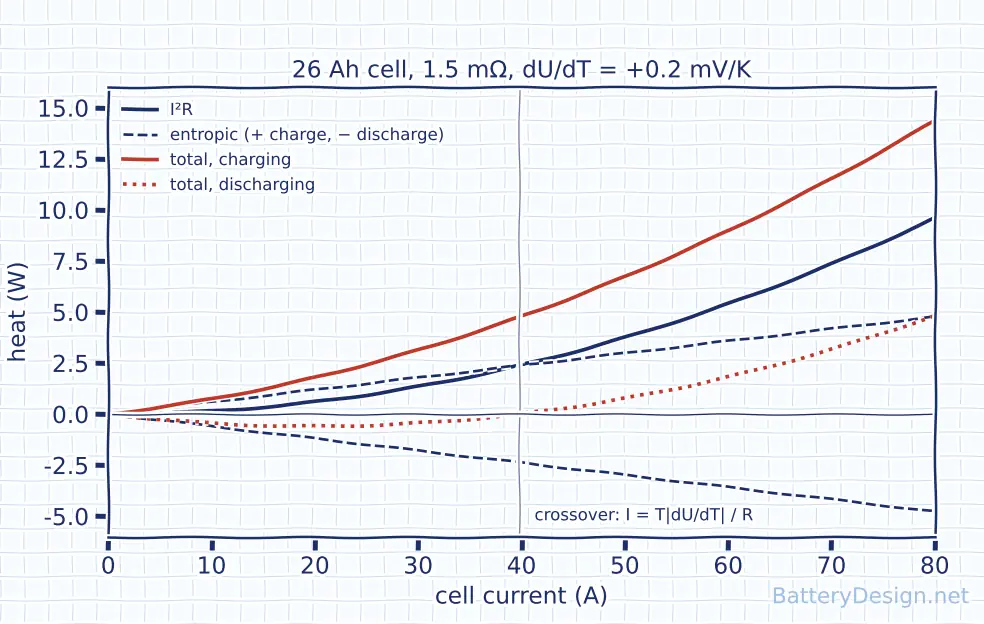
where Q̇ is the heat generated (W), I is the cell current (A), R is the cell resistance (Ω), T is the cell temperature (K) and dU/dT is the entropic coefficient, the change in open-circuit voltage with temperature (V/K). The first term is always positive. The second flips sign with the direction of current: with a positive dU/dT the cell absorbs heat on discharge and releases it on charge, and the reverse with a negative dU/dT. The simplified form leaves out heat of mixing and side reactions, which are small in normal operation.
Setting the two terms equal gives the current at which they match:
Below I* the entropic term is the bigger of the two. The pack heat is the cell heat multiplied by S × P, and with no cooling at all the cell temperature rises at Q̇ / (m cp). See Specific Heat Capacity of Lithium-Ion Cells for cp values; the calculator defaults to the 1,040 J/kg·K listed there for NMC.
How Big Is dU/dT?
Small, and it moves with state of charge. A 26 Ah NMC/LMO-graphite pouch cell measured by Geng, Groot and Thiringer stayed within ±0.3 mV/K across the SOC range, negative at 5 to 15% SOC and positive at 35 to 45%, with 0.2 mV/K at 50% SOC [3]. Wind and Vie measured entropy profiles for 14 commercial cells covering most common chemistries [4]. For their LFP, NMC and NCA cells, the SOC-averaged entropy is between −4 and +5 J/mol·K, and the standard deviation across SOC within each cell is 11 to 16 J/mol·K. Dividing by the Faraday constant, that is an average of −0.04 to +0.05 mV/K with a swing of roughly ±0.1 to 0.17 mV/K (our conversion, one electron per lithium).
Treat dU/dT as a function of SOC for the cell you have, not a single number for the chemistry. The coefficient also varies with temperature, most at the ends of the SOC window [2].
Worked Example
Take the 26 Ah cell from [3] at 50% SOC and 25 °C, with dU/dT = +0.2 mV/K and a resistance of 1.5 mΩ (an illustrative value, not from the paper):
| Load | I²R (W) | Entropic (W) | Total (W) |
|---|---|---|---|
| 1C discharge, 26 A | 1.01 | −1.55 | −0.54 |
| 1C charge, 26 A | 1.01 | +1.55 | 2.56 |
| 3C discharge, 78 A | 9.13 | −4.65 | 4.48 |
| 3C charge, 78 A | 9.13 | +4.65 | 13.8 |
At 1C discharge this cell cools itself slightly. At 3C charge, I²R alone gives 9.1 W against a real 13.8 W, a 34% underestimate, and at 3C discharge it gives double the real figure. A 108S2P pack of these cells at 3C charge makes about 3 kW, which needs 9.8 L/min of 50/50 water-glycol for a 5 K coolant rise.
What This Means for the Pack
- Size cooling on the charge case. With a positive dU/dT at mid SOC, fast charging adds the entropic heat to I²R. A discharge-based heat estimate will undersize the cold plate for fast charging.
- Pick the right resistance. A 10 s pulse DCIR is lower than the resistance a cell shows after minutes at constant current. Use a value that matches the duration of the load; see Internal Resistance: DCIR and ACIR.
- Low current is where the model matters. Below I*, ignoring the entropic term can get the sign of the heat wrong, which shows up as unexplained temperature drops in cell tests at low C-rate.
- Cells are not the only source. Busbars, welds, fuses and contactors add their own I²R; see Heat Sources and Paths in a Battery Pack.
References
- D. Bernardi, E. Pawlikowski and J. Newman, A General Energy Balance for Battery Systems, Journal of The Electrochemical Society, 132(1), 5–12, 1985. eScholarship
- S. J. Bazinski and X. Wang, The Influence of Cell Temperature on the Entropic Coefficient of a Lithium Iron Phosphate (LFP) Pouch Cell, Journal of The Electrochemical Society, 161(1), A168–A175, 2014. PDF
- Z. Geng, J. Groot and T. Thiringer, A Time and Cost Effective Method for Entropic Coefficient Determination of a Large Commercial Battery Cell, IEEE, 2020, doi:10.1109/TTE.2020.2971454. arXiv
- J. Wind and P. J. S. Vie, Entropy Profiles for Li-Ion Batteries: Effects of Chemistries and Degradation, Entropy, 27(4), 364, 2025. MDPI
See also: Heat Generation in a Cell, Coolant Flow Calculator, Internal Resistance: DCIR and ACIR, Specific Heat Capacity of Lithium-Ion Cells, Heat Sources and Paths in a Battery Pack, C-Rate Calculator, Battery Calculators
Get the next teardown in your inbox
New teardowns, benchmarks and design data from BatteryDesign.net, free by email. Unsubscribe any time.