
Lead-Acid and Lithium Codes Decoded
Author: Max Khabur, Marketing Director ENEROC USA
How forklift battery part numbers describe a battery, and how to use them to pick the right one for a lift truck. The worked example is a 48-volt Hyster E50XN, covering the standard lead-acid code and the ENEROC lithium product code, which puts voltage, capacity, dimensions and weight in one string.
Start with the truck
Every electric forklift has a battery spec. It is set by the truck manufacturer and published in battery selectors and service manuals. For the Hyster E50XN with a 33-inch compartment, the spec reads:
| Requirement | Hyster E50XN (48V / 33″) |
|---|---|
| Voltage | 48V |
| Compartment (L x W x H) | 39.10 x 33.30 x 23.90 in |
| Battery weight | 2,900 lb minimum, 3,900 lb maximum |
| Connector | SB350, blue |
| Cover | Not required |
A replacement battery has to meet every line in this table. A part number that lists these values lets a buyer check each line without consulting a spec sheet.
How lead-acid part numbers work
Most North American lead-acid forklift batteries are identified by three numbers separated by dashes. A common battery for the E50XN is a 24-85-21.
24 – 85 – 21
- 24 is the number of cells. Each lead-acid cell is nominally 2 volts, so 24 cells make a 48-volt battery.
- 85 is the capacity of one positive plate, in amp-hours, at the 6-hour discharge rate.
- 21 is the total number of plates in each cell. Every cell starts and ends with a negative plate, so 21 plates means 10 positive plates.
Capacity is the number of positive plates multiplied by the plate rating. For a 24-85-21, that is 10 x 85 = 850 Ah.
This code tells a buyer the voltage and the capacity. It says nothing about length, width or weight.
One truck, several batteries
The online selectors of three lead-acid manufacturers each return a different battery for the Hyster E50XN-33:
| Battery | Model code | Capacity | L x W x H (in) | Weight (lb) | Fits? |
|---|---|---|---|---|---|
| Lead-acid 1 | 24-E100-21 | 1,000 Ah | 38.27 x 32.66 x 22.75 | 3,360 | Yes |
| Lead-acid 2 | 24-85-21 | 850 Ah | 38.25 x 32.75 x 23.25 | 3,317 | Yes |
| Lead-acid 3 | 24-D85-21 | 850 Ah | 38.19 x 32.69 x 22.69 | 3,285 | Yes |
Each manufacturer writes the code slightly differently, some adding an internal catalogue letter, but every version still decodes to cell count, plate rating and plate count.
None of the three codes shows whether the battery fits. That takes the dimensions and weight, which a fleet manager comparing quotes has to collect from a separate spec sheet for each battery.
Even an identical model code can come in different sizes. A 48-volt tray chart lists the 24-85-13 in two trays:
| Model code | Tray | Capacity | L x W x H (in) | Weight (lb) |
|---|---|---|---|---|
| 24-85-13 | 132 | 510 Ah | 30 5/8 x 25 3/8 x 22 5/8 | 2,188 |
| 24-85-13 | 147 | 510 Ah | 38 1/8 x 20 1/2 x 22 5/8 | 2,194 |
The two batteries are electrically identical. Tray 147 is 7 1/2 inches longer and 4 7/8 inches narrower than tray 132.
Lithium part numbers
Lithium forklift battery model numbers usually state only voltage and amp-hours, sometimes with a product family name. There is no common format, and like the lead-acid code, they leave the buyer looking up dimensions and weight elsewhere.
Weight matters more with lithium. Lithium cells are much lighter than lead plates and acid, so a lithium battery for a counterbalance truck carries steel ballast to reach the truck’s minimum weight. If weight and dimensions are not in the part number, the buyer has to confirm them separately before the battery goes in the truck.
How to read an ENEROC USA product description code
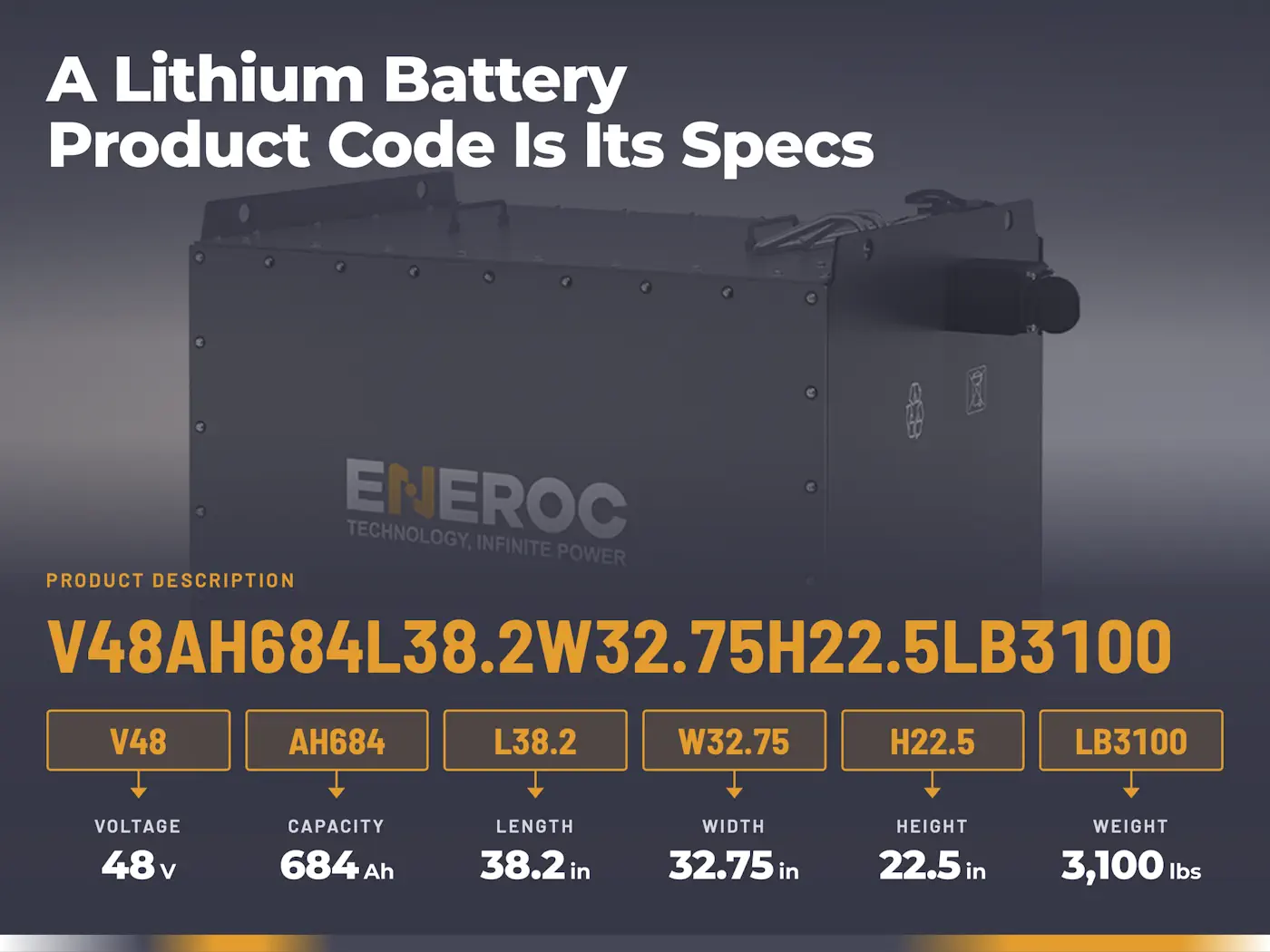
ENEROC USA writes the truck’s battery requirements into the product description code. Here is the ENEROC battery for the Hyster E50XN-33:
V48AH684L38.2W32.75H22.5LB3100
Each field starts with a letter tag, so the code reads left to right:
| Field | Reads as | Meaning |
|---|---|---|
| V48 | 48 volts | Truck voltage class |
| AH684 | 684 amp-hours | Rated capacity |
| L38.2 | 38.2 in | Length |
| W32.75 | 32.75 in | Width |
| H22.5 | 22.5 in | Height |
| LB3100 | 3,100 lb | Weight, including ballast |
The fields follow the same order as the truck’s battery spec, so each can be checked directly: 38.2 x 32.75 x 22.5 in fits the 39.10 x 33.30 x 23.90 in compartment, and 3,100 lb sits inside the 2,900–3,900 lb window. V48 is the truck’s voltage class; a 48 V lithium iron phosphate (LFP) pack is typically 16 cells in series at 3.2 V nominal, or 51.2 V. The code does not cover the connector (SB350, blue) or communication with the truck, which still need confirming.
Why the lithium amp-hour rating is lower than lead-acid
A lead-acid battery delivers less than its rated capacity in a forklift. The truck’s lift interrupt disables lifting at about 20% state of charge to protect the battery from deep discharge, so only about 80% of rated capacity is available. The interrupt can be set lower, but 20% is typical. The lead-acid rating is also taken at the 6-hour discharge rate, while a forklift draws higher, peaky currents for lifting and travel, and lead-acid capacity falls as current rises (the Peukert effect). Voltage sag under load and cold-store operation reduce it further. Together, these leave 60–70% of rated capacity usable in service.
Lithium iron phosphate behaves differently. Its capacity barely changes with discharge rate, its voltage stays flat under load, and the battery management system typically allows 90–100% of rated capacity to be used. As a starting point, ENEROC multiplies the lead-acid capacity, or the maximum capacity the truck will accept, by 0.6–0.7 to set the lithium capacity:
1,000 Ah x 0.6 = 600 Ah; 1,000 Ah x 0.7 = 700 Ah
ENEROC then asks about maximum fork height, attachments in use, changes to load center, shift duration and actual run times before recommending a capacity.
The ENEROC battery for this truck is rated at 684 Ah, against 850–1,000 Ah for the lead-acid batteries in the table. 684 Ah is 0.68 x 1,000 Ah, inside the 0.6–0.7 range.
This battery was selected from the truck’s battery spec alone. Answers to the application questions could change the recommendation (see the ENEROC battery sizing calculator).
Where industry nomenclature is heading
On October 6, 2026, Battery Council International (BCI) held the first meeting of its new Industrial Lithium Battery Subcommittee in Philadelphia. Its proposed projects include a lithium glossary of terms and standard measurement methods, and BCI will adapt its Battery Technical Manual standards for lithium (BCI announcement). A standardized nomenclature for motive power lithium batteries, paralleling the lead-acid code, would let a fleet manager compare any lithium battery with any lead-acid battery from the part number alone. ENEROC USA is a BCI member.
See also: Propane to Electric
Get the next teardown in your inbox
New teardowns, benchmarks and design data from BatteryDesign.net, free by email. Unsubscribe any time.