
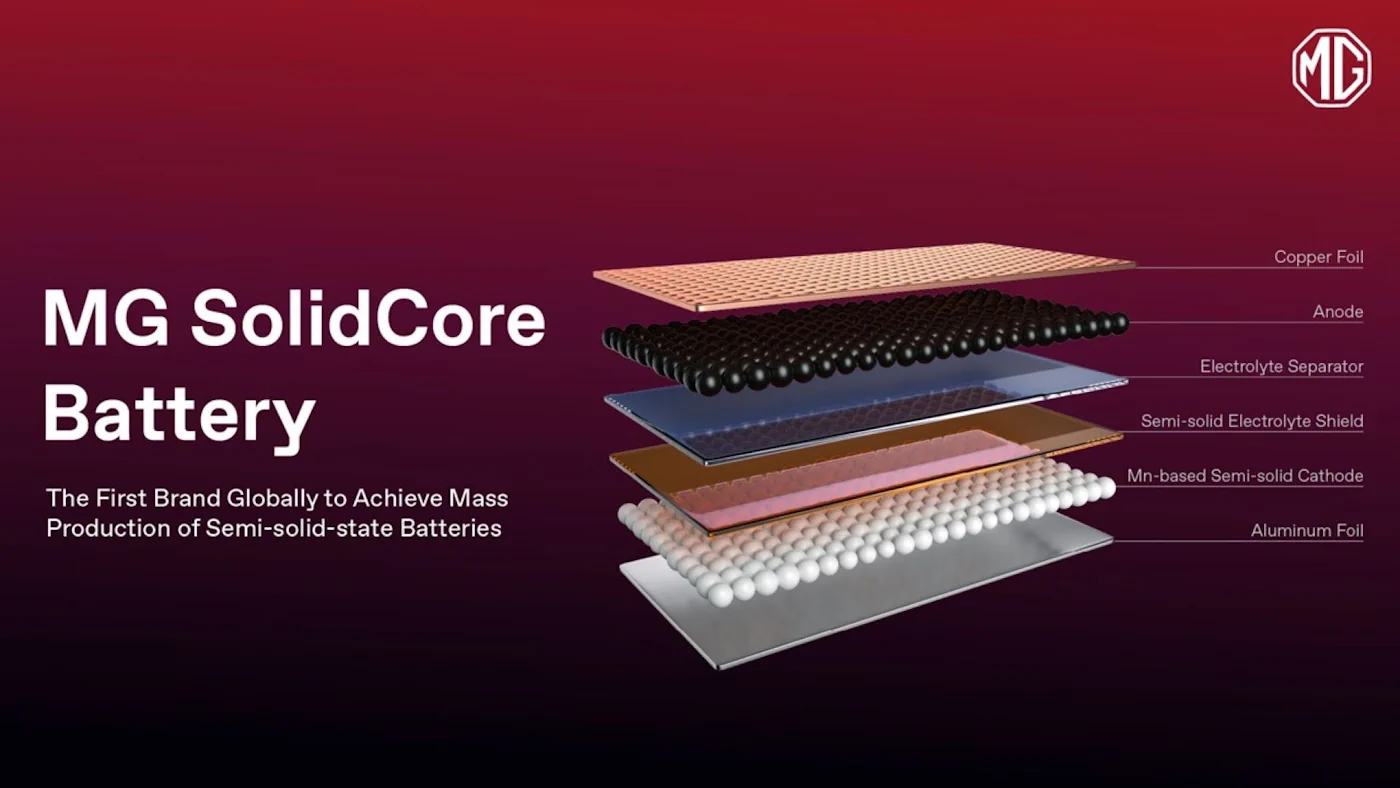
The MG4 Anxin Edition is being sold as the first mass-market car with a semi-solid-state pack. This is a pack analysis rather than a teardown report: a Chinese teardown channel has photographed the pack nameplate, a regulatory filing gives the pack mass, and the cell maker has shown a slide with the cell and string data, so we can now work from primary-style numbers and say where each one comes from. The question we care about is simple. Does this pack give an engineer anything that the LFP version of the same car does not? It sits alongside our Semi-Solid State Battery page and our look at solid-state production timelines.
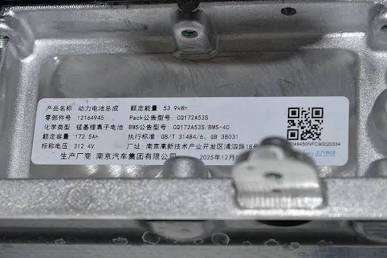
What the nameplate, the filing and the cell maker say
| Item | Value | Source |
|---|---|---|
| Pack rated energy | 53.9 kWh (1C); 56.2 kWh (0.33C) | Nameplate [5], MIIT filing [4], cell maker slide [6] |
| Pack rated capacity and voltage | 172.5 Ah, 312.4 V nominal | Nameplate [5] |
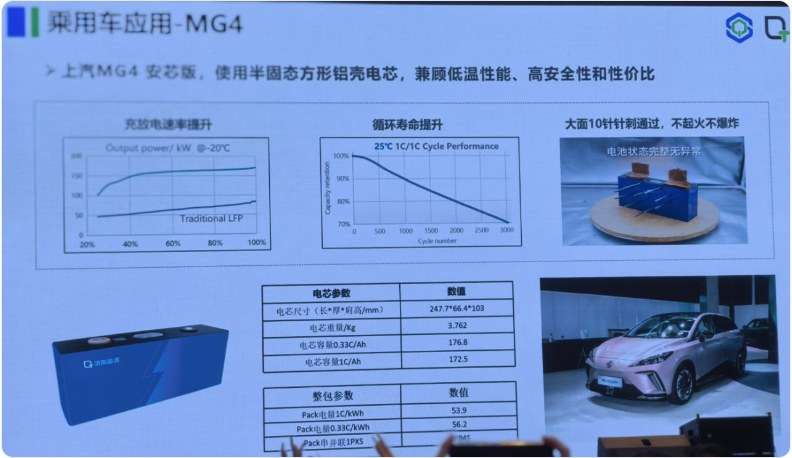
| Configuration | 1P84S | Text of the LinkedIn post that carried the slide [6] |
| Cell | 247.7 × 66.4 × 103 mm, 3.762 kg, 172.5 Ah (1C), 176.8 Ah (0.33C) | Cell maker slide [6] |
| Pack mass | 403 kg | MIIT filing [4] |
| Vehicle kerb mass | 1,500 kg | MIIT filing [4] |
| CLTC range | 530 km | MIIT filing [4] |
| Chemistry label | Manganese-based lithium-ion (锰基锂离子电池) | Nameplate [5], reported in the vehicle announcement [7] |
| Cell maker | Suzhou QingTao Power Technology | Reported in the vehicle announcement [7] |
| Pack assembler | Nanjing Automobile Group | Nameplate [5] |
The headline figures line up. The marketing figure of 53.95 kWh is the nameplate 53.9 kWh rounded up, and the 537 km that appeared in earlier coverage belongs to a pre-launch report of a larger 70 kWh pack [11]; the filing gives 530 km [4]. The 1,500 kg kerb mass is 15 kg above the 1,485 kg quoted for the 53.9 kWh LFP car [1]. Nothing on the label calls the pack semi-solid: the regulatory wording is simply manganese-based lithium-ion.
What our arithmetic says about the cell
The pack is 84 cells in series, so every figure below follows from the table. These are our estimates, not published specifications, and we have assumed the 53.9 kWh rating is the 1C value that the slide shows.
| Quantity | Working | Result (our estimate) |
|---|---|---|
| Cell nominal voltage | 312.4 V ÷ 84 | 3.72 V |
| Cell energy at 1C | 53.9 kWh ÷ 84 (or 172.5 Ah × 3.72 V) | about 642 Wh |
| Cell specific energy | 642 Wh ÷ 3.762 kg | about 171 Wh/kg |
| Cell specific energy at 0.33C | (56.2 kWh ÷ 84) ÷ 3.762 kg | about 178 Wh/kg |
| Cell volumetric energy | 642 Wh ÷ 1.69 L (external envelope) | about 380 Wh/L |
| Total cell mass in the pack | 84 × 3.762 kg | about 316 kg |
| Cell share of pack mass | 316 kg ÷ 403 kg | about 78% |
| Pack specific energy | 53.9 kWh ÷ 403 kg | about 134 Wh/kg |
The cell figure of 171 to 178 Wh/kg matches the 180 Wh/kg that earlier reports quoted without saying whether it was cell or pack level [3], so it is a cell figure. It is also nowhere near the 400 Wh/kg on the manufacturer’s SolidCore page [8], which is a roadmap number and not this cell. The 3.72 V average is the quiet engineering point: an LFP cell at about 3.2 V would need roughly 98 in series to reach the same 312 V, so the manganese-based cell buys a shorter string and fewer sense channels for the BMS. Our cell to pack mass ratio page shows how a 78% cell share compares with other packs; it is a good result for a pack of this size, but we have not yet confirmed what the 403 kg covers.
What semi-solid means here
Reports disagree on how much liquid is left. The manufacturer’s own page says a conventional lithium-ion cell holds about 20% liquid electrolyte and SolidCore holds 5%, with 95% solid [8]; AutoBuzz and the pre-launch CarNewsChina report repeat the 5% as the amount remaining [10][11], while other outlets read it as 5% less liquid than a conventional cell [12]. None of them gives a method. The cell maker’s own listing application calls its batteries solid-liquid hybrid (固液混合) and keeps the term all-solid-state for a separate product [9]. Our reading is that this is a liquid-solid hybrid cell with a gelled or solid-loaded phase, not a ceramic-separator solid-state cell. MG describes a spinel cathode architecture [8], and the vehicle announcement coverage notes it does not say whether the cathode is LMO or an LMR type [7], so we do not name one. For background see lithium manganese oxide, LMR cathodes and sodium-ion and semi-solid technologies.
Does it beat the LFP pack?
On energy, no. The rated energy is the same 53.9 kWh as the LFP car, and the CLTC range is the same 530 km [4]. On mass, if the rest of the two cars is identical, which we cannot confirm, the 15 kg kerb difference puts the LFP 53.9 kWh pack near 388 kg, or about 139 Wh/kg against 134 Wh/kg here. That is a gap of a few per cent, inside the uncertainty of the assumption, so we call it level, with no energy-density advantage for the semi-solid pack.
Charging tells the same story. A 30 to 80% window is 50% of 53.9 kWh, or about 27 kWh. Delivered in 21 minutes that is an average of about 77 kW, roughly 1.4C, against a quoted 2C capability [1]. The LFP version is quoted at 20 minutes for the same window [3]. Compare it with fast charging limits and the LFP page.
Where the case is made: cold, cost and scale
The slide shows output power at -20 °C well above a traditional LFP curve and a 25 °C 1C/1C cycle curve that we read as roughly 70 to 75% retention at 3,000 cycles [6]. Both are company claims from a photographed slide, with no test report behind them. A separate report puts the cold benefit at 13.8% better range retention at -7 °C against LFP [11], again as a claim. If those hold, the real benefit is winter performance and cost, not energy density.
On cost, QingTao’s listing application says its manganese-based cathode material generally costs less than established LFP cathode and about 30% of NCM (our translation of the Chinese text) [9]. Its average selling price for power battery products fell from RMB 0.60/Wh in 2024 to RMB 0.31/Wh in 2025, and the filing notes the 2025 figure is mostly single-cell prices [9]. That is an average across all of its power batteries, not the MG4 price, but at that level 53.9 kWh of cells would be about RMB 16,700 (our arithmetic, indicative only). Our reading is that the Anxin pack is a route to scale for QingTao and a cost and cold-weather play for SAIC, not a performance step.
What the safety claims do and do not prove
The slide shows a large-face 10-needle puncture test passed with no fire or explosion [6], and one report adds a 1,000 °C, 180 second fire exposure [10]. We did not find a test report for either. A single-cell puncture test says little about propagation in a full pack, and a cell that retains some liquid electrolyte still has a flammable component. The nameplate cites GB 38031 but the year is not legible in the photograph; see our GB 38031-2025 post for what the newer edition asks of a pack. Until a propagation test is published, treat the safety case as plausible, not demonstrated.
What to take from this
The pack is a normal 84-cell prismatic pack with a 3.72 V manganese-based cell, and it matches the LFP version on energy and range. The interesting claims are cold output, cycle life and cost, and each of those still rests on a company slide or a listing document. We would want a propagation test and an independent cold-weather test before calling it better than LFP. For other vehicle packs see benchmarking battery packs.
References
- Arena EV, Deliveries of MG4 Anxin Edition with semi-solid state battery start in China
- Motorist, MG4 Anxin Edition: World’s First Mass-Production EV with Semi-Solid State Battery Technology
- electrive, SAIC launches MG4, also with semi-solid-state battery, 1 September 2025
- Ministry of Industry and Information Technology, Catalog of New Energy Vehicles Exempt from Vehicle Purchase Tax, 21st batch, part 1 new models, item 7 (SAIC, CSA7004MBEV4), September 2025, third-party mirror of the PDF
- Da Biao Che, MG4拆车:半固态电池好不好?一次给你讲明白!, Autohome Chejiahao, 9 January 2026 (article text read in translation; nameplate photograph credit to be confirmed)
- Qingtao and SAIC MG4 Anxin presentation slide, photographed and posted by Woody Wu (Power9 Tech) on LinkedIn, cell and pack data
- CarNewsChina, Adrian Leung, MG4 semi-solid-state edition disclosed by Chinese regulator, 13 August 2025
- MG Motor Europe, SolidCore
- Qingtao (Kunshan) Energy Development Group, Hong Kong Stock Exchange listing application proof, 2026 (Chinese; excerpt read)
- AutoBuzz, MG4 Anxin Edition begins deliveries in China, 19 December 2025
- CarNewsChina, What is a semi-solid-state battery? MG4’s new tech sparks online debate ahead of pre-sale, 23 July 2025
- WhichCar, MG delivers world-first solid-state battery EV with new MG4 Anxin Edition
See also: Semi-Solid State Battery, Solid-State Production Timelines, Is the Move from LFP to LMFP Simple?, Prismatic Cells, Pack Gravimetric Energy Density
Get the next teardown in your inbox
New teardowns, benchmarks and design data from BatteryDesign.net, free by email. Unsubscribe any time.