
BMW has confirmed that the Neue Klasse will use LFP alongside its NMC round cells, and the first example is already on sale: the China-only 2026 iX3 30L (long wheelbase, NA6), which opened for orders in August 2026, entered production on 16 November and starts deliveries on 25 November with a 77 kWh LFP pack and 630 km CLTC range [1][2]. This is a companion to our BMW iX3 Neue Klasse Battery benchmark. The interesting engineering question is what happens when a pack housing designed around 4695 cylindrical NMC cells is filled with CATL prismatic LFP instead.

Headline numbers
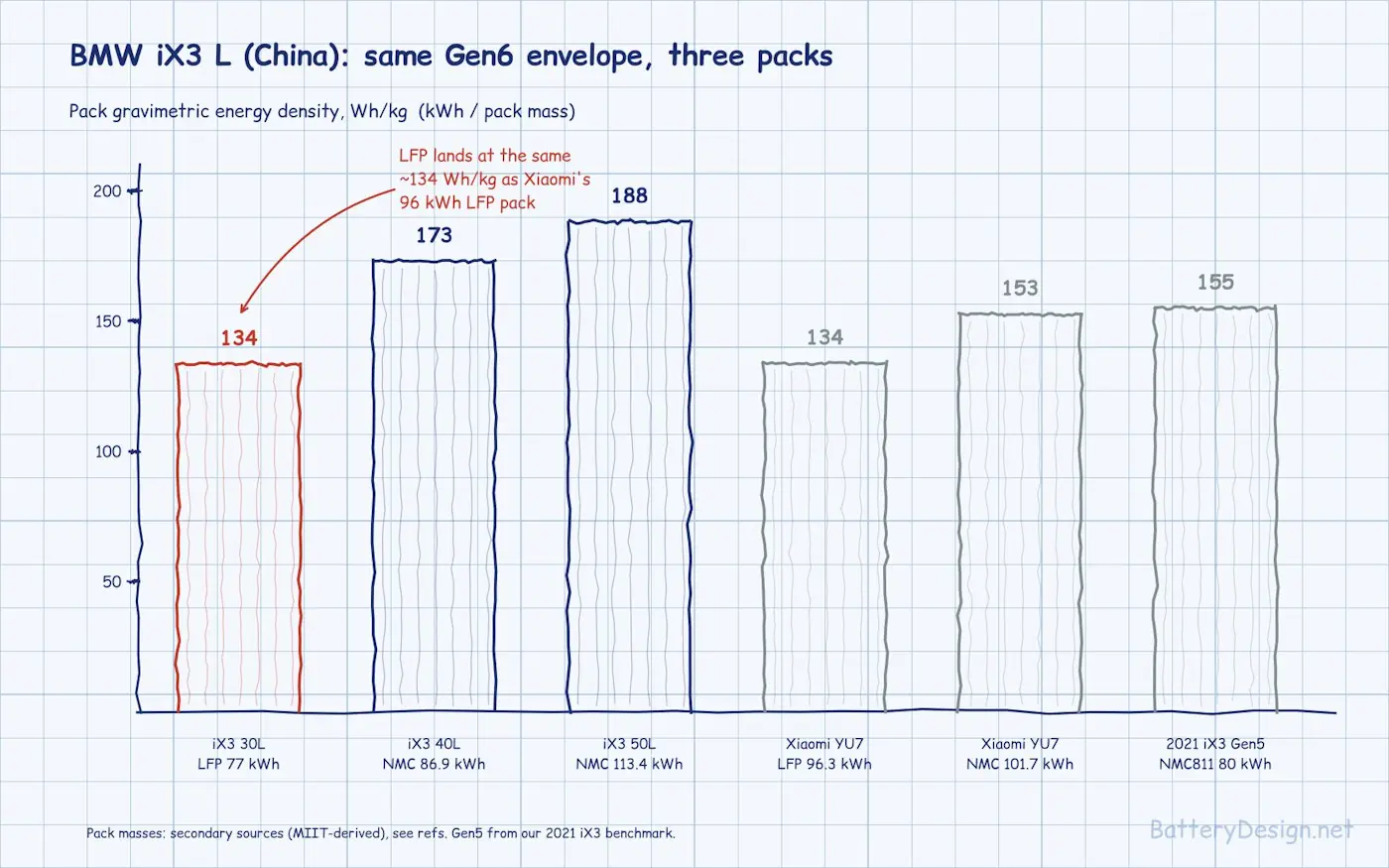
- Pack gravimetric energy density ~134 Wh/kg (our arithmetic: 77 kWh / 576.6 kg)
- Total energy = 77 kWh [2]
- Usable energy = 71.2 kWh, a 92.5% window, is quoted by one spec aggregator only [13]; BMW has not published it
- Chemistry = LFP, cells by Yibin Sanjiang Shidai (a CATL company), pack assembled by CATL [3]
- Pack mass = 576.6 kg (secondary source, see Pack mass below) [5]
- 800V class, 10 to 80% SoC in about 22 minutes [5]
- Range = 630 km CLTC, about 13 kWh/100 km [2]
- Vehicle: 2,237 kg kerb mass, single rear motor filed at 235 kW peak (marketed at 195 kW), 3,005 mm wheelbase [1][3]
- Price = RMB 269,900, against RMB 299,900 for the 40L xDrive [1]
Supply chain: a CATL pack, not a BMW one
The MIIT type approval filing (411th batch) settles the supplier question that early coverage left open. The cells come from Yibin Sanjiang Shidai, a CATL subsidiary in Sichuan, and the battery assembly is listed as CATL’s [1][3]. That is a different split from the 40L and 50L, where BMW Brilliance builds the cylindrical packs in its own Shenyang plant; Chinese reporting has CATL and EVE dual sourcing the 40L cells and EVE alone on the 50L [9].
CATL describes the pack as a five-year development based on its Qilin (CTP 3.0) platform, exclusive to BMW, already delivering and nominated for Europe [7][8]. Reporting from BMW’s China Import Expo presentation on 5 November describes the 30L as using CATL prismatic LFP cells, with the 40L and 50L on large cylindrical NMC [10]. At launch in August, the format had not been officially disclosed [16]. BMW has not issued a spec sheet, and neither BMW nor CATL has published cell capacity, mass or energy density. CATL’s BMW project lead did say the pack weighs well below an industry average for comparable packs of around 600 kg [17], which fits the 576.6 kg figure below.
Some secondary analyses assume the LFP pack reuses 4695 cylindrical cells in the same 192s5p layout. We think that is wrong: the filing has CATL, not BMW, assembling the pack; CATL calls it a Qilin-based pack; and 192s of LFP would sit at about 480 V to 700 V, largely below the 540 V to 816 V window of the NMC packs. It would also need an LFP round cell of around 500 Wh/L, well beyond anything published for the chemistry.
BMW’s position is that Gen6 is technology-open, with the 30L, 40L and 50L packs sharing a common hardware volume, and with prismatic and cylindrical routes running in parallel [8]. Our reading is that the housing, seat-rail interfaces and pack-to-open-body structure carry over, and the cell-to-pack interior is CATL’s.
Pack mass and energy density
The pack masses below come from a secondary source, a Wikipedia specification table with no citation against them [5]. We would not normally lean on that, but one MIIT number cross-checks them. The 30L (LFP, one motor) files at 2,237 kg and the 40L xDrive (NMC, two motors) at 2,255 kg, only 18 kg apart [1][14]. With the LFP pack 74 kg heavier, the front induction motor, inverter and driveshafts on the 40L would need to weigh roughly 90 kg, which is plausible. We treat the masses as probable rather than confirmed.
| Pack | Chemistry / format | Energy (kWh) | Mass (kg) | Wh/kg | CLTC (km) |
|---|---|---|---|---|---|
| 2026 iX3 30L (NA6) | LFP / prismatic | 77.0 | 576.6 | 134 | 630 |
| 2026 iX3 40L xDrive (NA6) | NMC / 4695 | 86.9 | 502.3 | 173 | 702 |
| 2026 iX3 50L xDrive (NA6) | NMC / 4695 | 113.4 | 602.7 | 188 | 919 |
| 2025 Xiaomi YU7 | LFP / Blade | 96.3 | 720 | 134 | 835 |
| 2025 Xiaomi YU7 | NMC / Qilin | 101.7 | 666 | 153 | 760 |
| 2021 iX3 (Gen5) | NMC811 / prismatic | 80.3 | 518 | 155 | n/a |
Three points come out of this table.
- The LFP pack is ordinary on Wh/kg. At 134 Wh/kg it matches Xiaomi’s 96.3 kWh LFP pack almost exactly and sits above our Zeekr 007 LFP (128 Wh/kg) and Ford Mach-E LFP (120 Wh/kg) benchmarks. It is well short of the 160 Wh/kg CATL claimed for LFP Qilin systems at launch [11].
- The volume penalty is about a third. If the housing really is common, LFP puts 77 kWh where the 50L puts 113.4 kWh: 68% of the energy in the same box. The 40L holds 86.9 kWh, so the LFP fill is 89% of that. A reader comment on our iX3 page lists an 87.8 kWh 184s4p variant, which may be a partly populated version of the same housing, but nothing ties it to the China 40L.
- The LFP pack is 74 kg heavier than the 40L pack for 10 kWh less. On a 2.2 tonne SUV this is not dramatic, but it is the price of the cheaper chemistry.
Estimating the cell
Nothing has been published at cell level, so this section is our arithmetic and should be read as bounds, not a specification.
Series count. The cylindrical packs run 540 V to 816 V, which is exactly 192s at 2.81 V to 4.25 V per cell and matches the 192s5p in our 50L benchmark (the voltage window comes from Chinese owner-guide coverage rather than BMW [15]). If the LFP pack must sit in the same window for the shared inverter and charging hardware, then with LFP limits of 2.5 V and 3.65 V the series count is bounded at 216s to 223s. At 3.2 V nominal that gives roughly 690 V to 715 V.
| Series count (1p) | Nominal (V) | Range at 2.5 to 3.65 V (V) | Cell capacity (Ah) | Cell energy (Wh) |
|---|---|---|---|---|
| 216s | 691 | 540 to 788 | 111 | 356 |
| 220s | 704 | 550 to 803 | 109 | 350 |
| 222s | 710 | 555 to 810 | 108 | 347 |
Cell mass and cell-to-pack ratio. For an LFP cell at 165 to 185 Wh/kg, the cells weigh 416 kg to 467 kg, leaving 110 kg to 160 kg for everything else and a cell-to-pack mass ratio of 72% to 81%. Our 50L estimate has around 190 kg of non-cell mass. If the LFP pack carried the same 190 kg, the cells would have to reach about 199 Wh/kg, which is at the very top of what high-compaction LFP is reported to do. Our reading is that the LFP interior is lighter than the cylindrical one (fewer, larger cells, fewer busbars and sensing points) while the shared structure keeps the total from reaching Qilin’s headline figure.
Charging
- 10 to 80% in about 22 minutes, against 21 minutes for the NMC versions [5]
- Average power over that window ~147 kW (our arithmetic: 0.7 × 77 kWh in 22 minutes), about 1.9C on total energy
- The same calculation gives 174 kW for the 40L and 227 kW for the 50L, both about 2.0C
- Peak DC power for the 30L has not been published by BMW; one spec aggregator lists 260 kW [13]
- AC charging is 7 kW, taking 10.75 hours for a full charge [4]
So the LFP pack charges at essentially the same C-rate as the high-nickel round cells. Nothing here suggests BMW de-rated the LFP variant; the shorter absolute power comes from the smaller pack.
Range
630 km is a CLTC figure and should not be read against WLTP. The standard-wheelbase European iX3 50 xDrive (NA5, a different body) rates about 805 km WLTP [5] against 919 km CLTC for the 50L, a ratio of 0.88. Applying it anyway gives about 550 km WLTP for the 30L; we would treat 500 km to 550 km as the realistic band.
Safety
CATL states that BMW set bottom-impact and side-impact requirements well above the Chinese national standard’s 120 J bottom impact and the typical 12 to 13 km/h side tests, and that BMW project cells are held to a parts-per-billion failure rate [6][7]. These are supplier claims made on a BMW-hosted media visit; no test levels or reports have been published.
The “20% cheaper” claim
Several English-language reports say the LFP pack is about 20% cheaper. We traced this to a general statement that LFP “tends to be around 20% cheaper to produce” in BMWBLOG’s launch piece, with no source behind it [2]. It is not a BMW figure. If anything the one supplier comment points the other way: CATL said its BMW LFP and cylindrical projects cost more than its other projects because it is building a technology premium rather than cutting material cost [6]. The RMB 30,000 price step to the 40L also buys a second motor, so it does not isolate the pack.
What to take from this
The 30L shows that BMW’s Gen6 housing really can take a second cell technology from a second integrator, and that the charging and 800V hardware cope with LFP without visible compromise. The cost is volumetric: about a third less energy in the same envelope and a pack that lands at a typical LFP 134 Wh/kg. That trade is fine for a China entry model at 630 km CLTC. For Europe, where the nomination already exists, the same pack would be nearer 500 km WLTP, which is the number BMW will have to sell it on.
References
- BMW Neue Klasse iX3 appears in China’s regulatory filing catalog, CnEVPost, 8 September 2026
- China’s Entry-Level BMW iX3 Uses A Different Battery Chemistry, BMWBLOG, 22 August 2026
- 华晨宝马新世代iX3纯电SUV申报 (MIIT 411th batch filing), IT之家 via Tencent News, 8 September 2026 (Chinese)
- 2026 BMW iX3 L in China: new 30L with LFP battery joins 40L and 50L, Paul Tan’s Automotive News, 21 August 2026
- BMW iX3, China specifications table, Wikipedia, accessed 24 November 2026 (battery masses uncited)
- BMW’s Neue Klasse goes local in China, BigGo Finance, November 2026
- 十五年电芯同行:宝马新世代的品质战, The Paper, November 2026 (Chinese)
- 揭秘:宁德时代如何与宝马合作生产第六代电池?, Zhihu, November 2026 (Chinese)
- 不走捷径的宝马新世代,为一块电池花了近10年, TMTPost, October 2026 (Chinese)
- 宝马新世代 iX3 与 i3 进博会亮相, Wangtongshe via ifeng Auto, 5 November 2026 (Chinese)
- 宁德时代官宣明年量产的麒麟电池, CLS, 2022 (Chinese)
- 小米YU7新消息曝光, Autohome Chejiahao, 2025 (Chinese)
- BMW iX3 30L, EVKX, accessed 24 November 2026
- 申报235kW、手册195kW、整备2237kg, SMZDM, September 2026 (Chinese)
- 宝马ix3纯电动车的电池类型是什么?, Weibo, 2026 (Chinese, low-confidence source)
- 26.99万的新世代iX3,宝马这次不想再打五折了, Tencent News, 24 August 2026 (Chinese)
- 宝马新世代“功夫车”背后:宁德时代与唐山爱信, ifeng Auto, November 2026 (Chinese)
See also: BMW iX3 Neue Klasse Battery, BMW Gen6 EV Battery Technology, 2021 BMW iX3, Zeekr 007 LFP, Ford Mach-E LFP, Pack Gravimetric Energy Density, Benchmarking Battery Packs
Get the next teardown in your inbox
New teardowns, benchmarks and design data from BatteryDesign.net, free by email. Unsubscribe any time.