Magnetic Fields Inside EVs: What the Measurements Show and Where They Come From
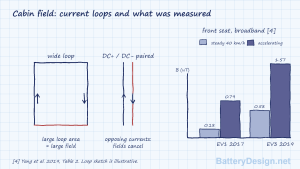
Hand-drawn sketch on squared paper: a wide current loop producing a large field, a paired DC plus and DC minus conductor pair whose fields cancel, and a bar chart of measured front-seat magnetic flux density in microtesla for two electric cars at steady speed and under acceleration.

Do electric vehicles expose their occupants to electromagnetic fields? Yes, to low-frequency magnetic fields, and the published measurements put most readings below the public reference levels, with a few that need a closer look. This post sets out what the measurements show, then treats it as a design topic: the field comes from current loops … Read more
Megawatt Charging: What 1,000 kW and 10C Mean for Cell and Pack Design

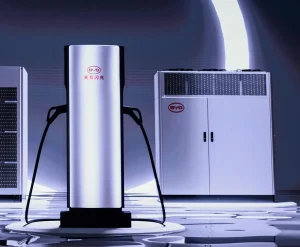
BYD megawatt charger

Megawatt charging for passenger cars has moved from a slide-deck number to a product. BYD describes a platform that moves energy at 1,000 kW, and in March 2026 it said a second-generation Blade battery can take up to 1,500 kW at its newest chargers.[1] This post looks at what those numbers ask of the cell, … Read more

10-80% Charge time is falling by 1.7 minutes a Year

10 to 80% charge time versus year of sale

In 2019 the median 10-80% charge time for BEV road cars was 39 minutes. In 2026 that median has fallen to 22 minutes. The fastest quoted pack in our database is 6.5 minutes and that is the 3rd generation of CATL Shenxing pack. Over this timeframe there has been a steady increase in the peak … Read more

EV Pack Charging Time

screenshot of the charging time estimator form

A pack charging time estimator built using the Electric Vehicle packs in the Battery Pack Database. EV Pack Charging Time Calculator EV Pack Charging Time Calculator Estimates DC fast-charge time from pack size, chemistry, peak charging power, and a SoC window, then layers on a simplified thermal model — starting pack temperature, pack mass, and … Read more

Non-Linear Voltammetry Charging Method

NLV charging process schematic

The Non-Linear Voltammetry (NLV) charging method differs from Constant Current (CC) based charging methods in that no CC is applied at any time. Instead, a series of short Constant Voltage (CV) steps are applied, separated with very short rest periods while monitoring the current response and temperature. A transition from one CV plateau to the … Read more

Constant Current – Constant Voltage Charging

CV-CC charging graph

Constant Current – Constant Voltage Charging (CC-CV) is where a battery cell is charged at a constant current until it reaches the maximum charging voltage at which point the voltage is fixed and the current reduced. The following graph shows this relationship versus charge time. The constant current charging up to 4.2V is at 0.5C … Read more

Fast Charging of a Lithium-Ion Battery

Poster on fast charging modelling and optimisation

Charging Current Control Strategy Based on Online Evaluation of the Chargeability Status of its Cells Authors: DIAB Raymonda, SCHAEFFER Emmanuel, AUGER François, POIZOT Philippe, COUSSEAU Jean-François Context Charging time reduction allows : Challenges Standard fast charging methods of Li-ion batteries : Methodology This algorithm enhances the charging current in order to maintain the observed overpotential … Read more

Cell to Pack Fast Charging

cell to module to pack fast charge times

While individual battery cells can charge in under 15 minutes, EV battery packs take much longer to fully charge. There are a number of factors that influence that, including temperature spread across the pack. Key Factors Limiting Battery Cell Lifetime During Charging At the cell level, the fastest rate at which a battery cell can … Read more

Electric Vehicle Range Calculator

Use this EV Range Calculator to predict your electric vehicle’s driving range based on real-world conditions. Select your vehicle (Tesla Model 3 or VW ID.4) or input custom specs to get a tailored estimate. Custom EV Range Estimator Your Estimated EV Range 0 km Select Your Vehicle Choose a preset vehicle or use custom settings: … Read more